Peter Michael Falk (September 16, 1927 – June 23, 2011) was an American actor, best known for his role as
Lieutenant Columbo in the long-running television series
Columbo (1968-2003), for which he received four
Primetime Emmy Awards and one
Golden Globe Award.
He was twice nominated for the
Academy Award for Best Supporting Actor, first for
Murder, Inc. (1960) and again for
Pocketful of Miracles (1961). Falk further appeared in films such as
It's a Mad, Mad, Mad, Mad World (1963),
The Great Race (1965),
A Woman Under the Influence (1974),
Murder by Death (1976),
The Princess Bride (1987),
The Player (1992),
Corky Romano (2001) and
Next (2007), as well as many television guest roles. Director
William Friedkin said of Falk's role in his film
The Brink's Job (1978): "Peter has a great range from comedy to drama. He could break your heart or he could make you laugh."
Falk was the first actor to be nominated for an Academy Award and an Emmy Award in the same year, achieving the feat two years in a row, in 1960 and again in 1961.
In 1968, Falk starred with
Gene Barry in a ninety-minute television movie about a highly skilled, laid-back detective.
Columbo eventually became part of an anthology series titled
The NBC Mystery Movie, along with
McCloud,
McMillan & Wife and
Banacek. The detective series stayed on NBC from 1971 to 1978, took a respite, and returned occasionally on ABC from 1989 to 2003. Falk was "everyone's favorite rumpled television detective", wrote historian David Fantle.
In 1996,
TV Guide ranked Falk number 21 on its 50 Greatest TV Stars of All Time list.
Outstanding Performance by a Lead Actor in a Miniseries or Movie Primetime Emmy Award winners. People from Ossining, New York. American television producers, Best Drama Actor Golden Globe (television) winners.
American memoirists was family were American people of Czech-Jewish descent, of Hungarian-Jewish descent, of Polish-Jewish descent, of Russian-Jewish descent.
Burials at Westwood Village Memorial Park Cemetery
Cancer survivors
Early life
Born in
New York City, Falk was the son of Michael Peter Falk (1897–1981), owner of a clothing and
dry goods store, and his wife, Madeline (née Hochhauser; 1904–2003),an accountant and
buyer. Both of his parents were
Jewish, coming from
Poland and
Russia on his father's side, and from
Hungary and the
Czech lands on his mother's side.
Falk's right eye was surgically removed when he was three because of a
retinoblastoma; he wore an
artificial eye for most of his life. The artificial eye was the cause of his trademark squint. Despite this limitation, as a boy he participated in team sports, mainly baseball and basketball. In a 1997 interview in
Cigar Aficionado magazine with
Arthur Marx, Falk said: "I remember once in high school the umpire called me out at third base when I was sure I was safe. I got so mad I took out my glass eye, handed it to him and said, 'Try this.' I got such a laugh you wouldn't believe."
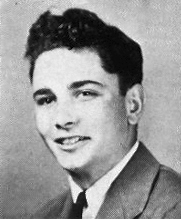
Falk as a senior in high school, 1945.
Falk's first stage appearance was at the age of 12 in
The Pirates of Penzance at
Camp High Point in upstate New York, where one of his camp counselors was
Ross Martin (they would later act together in
The Great Race and the
Columbo episode "Suitable For Framing"). Falk attended
Ossining High School in
Westchester County, New York, where he was a star athlete and president of his senior class. After graduating from high school in 1945, Falk briefly attended
Hamilton College in Clinton, New York, and then tried to join the armed services as
World War II was drawing to a close. Rejected because of his missing eye, he joined the
United States Merchant Marine, and served as a cook and mess boy. Falk said of the experience in 1997: "There they don't care if you're blind or not. The only one on a ship who has to see is the captain. And in the case of the
Titanic, he couldn't see very well, either." Falk recalls this period in his autobiography: "A year on the water was enough for me, so I returned to college. I didn't stay long. Too itchy. What to do next? I signed up to go to Israel to fight in the war on its attack on Egypt; I wasn't passionate about Israel, I wasn't passionate about Egypt, I just wanted more excitement… I got assigned a ship and departure date but the war was over before the ship ever sailed."
After a year and a half in the Merchant Marine, Falk returned to Hamilton College and also attended the University of Wisconsin. He transferred to the
New School for Social Research in New York City, which awarded him a bachelor's degree in literature and political science in 1951. He then traveled in Europe and worked on a railroad in
Yugoslavia for six months. He returned to New York, enrolling at
Syracuse University, but he recalled in his 2006 memoir,
Just One More Thing, that he was unsure what he wanted to do with his life for years after leaving high school.
Falk obtained a
Master of Public Administration degree at the
Maxwell School of
Syracuse University in 1953. The program was designed to train civil servants for the federal government, a career that Falk said in his memoir he had "no interest in and no aptitude for". He applied for a job with the
CIA, but was rejected because of his membership in the
Marine Cooks and Stewards Union while serving in the Merchant Marine, even though he was required to join and was not active in the union (which had been under fire for communist leanings). He then became a management analyst with the Connecticut State Budget Bureau in
Hartford. In 1997, Falk characterized his Hartford job as "efficiency expert": "I was such an efficiency expert that the first morning on the job, I couldn't find the building where I was to report for work. Naturally, I was late, which I always was in those days, but ironically it was my tendency never to be on time that got me started as a professional actor."
Stage career
While working in Hartford, Falk joined a community theater group called the Mark Twain Masquers, where he performed in plays that included
The Caine Mutiny Court-Martial,
The Crucible, and
The Country Girl by
Clifford Odets. Falk also studied with
Eva Le Gallienne, who was giving an acting class at the
White Barn Theatre in
Westport, Connecticut. Falk later recalled how he "lied his way" into the class, which was for professional actors. He drove down to Westport from Hartford every Wednesday, when the classes were held, and was usually late. In his 1997 interview with
Arthur Marx in
Cigar Aficionado Magazine, Falk said of Le Gallienne: "One evening when I arrived late, she looked at me and asked, 'Young man, why are you always late?' and I said, 'I have to drive down from Hartford.'" She looked down her nose and said, "What do you do in Hartford? There's no theater there. How do you make a living acting?" Falk confessed he wasn't a professional actor. According to him Le Gallienne looked at him sternly and said: "Well, you should be." He drove back to Hartford and quit his job. Falk stayed with the Le Gallienne group for a few months more, and obtained a letter of recommendation from Le Galliene to an agent at the
William Morris Agency in New York. In 1956, he left his job with the Budget Bureau and moved to
Greenwich Village to pursue an acting career.
Falk's first New York stage role was in an
Off-Broadway production of
Molière's
Don Juan at the Fourth Street Theatre that closed after its only performance on January 3, 1956. Falk played the second lead, Sganarelle. His next theater role proved far better for his career. In May, he appeared at
Circle in the Square in a revival of
The Iceman Cometh with
Jason Robards playing the bartender.
Later in 1956, Falk made his Broadway debut, appearing in
Alexander Ostrovsky's
Diary of a Scoundrel. As the year came to an end, he appeared again on Broadway as an English soldier in
Shaw's
Saint Joan with
Siobhán McKenna.
In 1972, Falk appeared in Broadway's
The Prisoner of Second Avenue. According to film historian
Ephraim Katz: "His characters derive added authenticity from his squinty gaze, the result of the loss of an eye ..."
Early films

In
Pocketful of Miracles (1961).
Despite his stage success, a theatrical agent advised Falk not to expect much
film acting work because of his artificial eye. He failed a screen test at
Columbia Pictures and was told by studio boss
Harry Cohn: "For the same price I can get an actor with two eyes." He also failed to get a role in the film
Marjorie Morningstar, despite a promising interview for the second lead. His first film performances were in small roles in
Wind Across the Everglades (1958),
The Bloody Brood (1959) and
Pretty Boy Floyd (1960). Falk's performance in
Murder, Inc. (1960) was a turning point in his career. He was cast in the supporting role of killer
Abe Reles in a film based on the real-life
murder gang of that name that terrorized New York in the 1930s.
The New York Times film critic
Bosley Crowther while dismissing the movie as "an average gangster film" singled out Falk's "amusingly vicious performance." Crowther wrote:
Mr. Falk, moving as if weary, looking at people out of the corners of his eyes and talking as if he had borrowed Marlon Brando's chewing gum, seems a travesty of a killer, until the water suddenly freezes in his eyes and he whips an icepick from his pocket and starts punching holes in someone's ribs. Then viciousness pours out of him and you get a sense of a felon who is hopelessly cracked and corrupt.
The film turned out to be Falk's breakout role. In his autobiography,
Just One More Thing (2006), Falk said his selection for the film from thousands of other
Off-Broadway actors was a "miracle" that "made my career" and that without it, he would not have gotten the other significant movie roles that he later played. Falk, who played Reles again in the 1960 TV series
The Witness, was nominated for a
Best Supporting Actor Academy Award for his performance in the film.
In 1961, multiple Academy Award-winning director
Frank Capra cast Falk in the comedy
Pocketful of Miracles. The film was Capra's last feature, and although it was not the commercial success he hoped it would be, he "gushed about Falk's performance". Falk was nominated for an Oscar for the role. In his autobiography, Capra wrote about Falk:
The entire production was agony ... except for Peter Falk. He was my joy, my anchor to reality. Introducing that remarkable talent to the techniques of comedy made me forget pains, tired blood, and maniacal hankerings to murder Glenn Ford (the film's star). Thank you Peter Falk."
For his part, Falk says he "never worked with a director who showed greater enjoyment of actors and the acting craft. There is nothing more important to an actor than to know that the one person who represents the audience to you, the director, is responding well to what you are trying to do." Falk recalled one time how Capra reshot a scene even though he yelled "Cut and Print," indicating the scene was finalized. When Falk asked him why he wanted it reshot: "He laughed and said that he loved the scene so much he just wanted to see us do it again. How's that for support!"
For the remainder of the 1960s, Falk had mainly supporting movie roles and TV guest-starring appearances. Falk turned in a gem of a performance as one of two cabbies who falls victim to greed in the epic 1963 star-studded comedy
It's a Mad, Mad, Mad, Mad World, although he only appears in the last fifth of the movie. His other roles included the character of Guy Gisborne in the
Rat Pack musical comedy
Robin and the 7 Hoods (1964), in which he sings one of the film's numbers, and the spoof
The Great Race (1965) with
Jack Lemmon and
Tony Curtis.
Early television roles
Falk first appeared on television in 1957, in the dramatic anthology programs that later became known as the "
Golden Age of Television." In 1957, he appeared in one episode of
Robert Montgomery Presents. He was also cast in
Studio One, Kraft Television Theater, New York Confidential, Naked City, The Untouchables,
Have Gun–Will Travel, The Islanders, and
Decoy with
Beverly Garland cast as the first female police officer in a series lead. On
The Twilight Zone he portrayed a
Castro-type revolutionary complete with beard who, intoxicated with power, kept seeing his would-be assassins in a newly acquired magic mirror. He starred in two of
Alfred Hitchcock's television series, as a gangster terrified of death in a 1961 episode of
Alfred Hitchcock Presents and as a homicidal evangelist in 1962's
The Alfred Hitchcock Hour.
In 1961, Falk was nominated for an
Emmy Award[33] for his performance in the episode "Cold Turkey" of
James Whitmore's short-lived series
The Law and Mr. Jones on
ABC. On September 29, 1961, Falk and
Walter Matthau guest-starred in the premiere episode, "The Million Dollar Dump", of ABC's crime drama
Target: The Corruptors, with
Stephen McNally and
Robert Harland. He won an Emmy for
The Price of Tomatoes, a drama carried in 1962 on
The Dick Powell Show.
[26]
In 1963, Falk and
Tommy Sands appeared as brothers who disagreed on the route for a railroad in "The Gus Morgan Story" on ABC's
Wagon Train. Falk played the title role of "Gus", and Sands was his younger brother, Ethan Morgan. Ethan accidentally shoots wagonmaster Chris Hale, played by
John McIntire, while the brothers are in the mountains looking at possible route options. Gus makes the decision to leave Hale behind even choking him, believing he is dead. Ethan has been overcome with oxygen deprivation and needs Gus' assistance to reach safety down the mountain. Unknown to the Morgans, Hale crawls down the mountain through snow, determined to obtain revenge against Gus. In time, though, Hale comes to understand the difficult choice Morgan had to make, and the brothers reconcile their own differences. This episode is remembered for its examination of how far a man will persist amid adversity to preserve his own life and that of his brother.
Falk's first television series was in the title role of the drama
The Trials of O'Brien, in which he played a lawyer. The show ran in 1965 and 1966 and was cancelled after 22 episodes.
In 1971,
Pierre Cossette produced the first
Grammy Awards show on television with some help from Falk. Cossette writes in his autobiography, "What meant the most to me, though, is the fact that Peter Falk saved my ass. I love show business, and I love Peter Falk."
Columbo
Although Falk appeared in numerous other television roles in the 1960s and 1970s, he is best known as the star of the TV series
Columbo, "everyone's favorite rumpled television detective." His character was a shabby and ostensibly absent-minded police detective lieutenant, who had first appeared in the 1968 film
Prescription: Murder. Rather than a
whodunit, the show typically revealed the murderer from the beginning, then showed how the
Los Angeles police detective Columbo went about solving the crime. Falk would describe his role to Fantle:
Columbo has a genuine mistiness about him. It seems to hang in the air… [and] he's capable of being distracted… Columbo is an ass-backwards Sherlock Holmes. Holmes had a long neck, Columbo has no neck; Holmes smoked a pipe, Columbo chews up six cigars a day.
Television critic Ben Falk (no relation) added that Falk "Created an iconic cop… who always got his man (or woman) after a tortuous cat-and-mouse investigation". He also noted the idea for the character was, "Apparently inspired by Dostoyevsky's dogged police inspector, Porfiry Petrovich, in the novel
Crime and Punishment.
Falk tries to analyze the character and notes the correlation between his own personality and Columbo's:
I'm a Virgo Jew, and that means I have an obsessive thoroughness. It's not enough to get most of the details, it's necessary to get them all. I've been accused of perfectionism. When Lew Wasserman (head of Universal Studios) said that Falk is a perfectionist, I don't know whether it was out of affection or because he felt I was a monumental pain in the ass.
With "general amazement", Falk notes: "The show is all over the world. I've been to little villages in Africa with maybe one TV set, and little kids will run up to me shouting, 'Columbo, Columbo!'" Singer
Johnny Cash recalled acting in one episode, and although he was not an experienced actor, he writes in his autobiography: "Peter Falk was good to me. I wasn't at all confident about handling a dramatic role, and every day he helped me in all kinds of little ways."
The first episode of
Columbo as a series was directed in 1971 by a 24-year-old
Steven Spielberg in one of his earliest directing jobs. Falk recalled the episode to Spielberg biographer
Joseph McBride:
Let's face it, we had some good fortune at the beginning. Our debut episode, in 1971, was directed by this young kid named Steven Spielberg. I told the producers, Link and Levinson: "This guy is too good for Columbo"... Steven was shooting me with a long lens from across the street. That wasn't common twenty years ago. The comfort level it gave me as an actor, besides its great look artistically—well, it told you that this wasn't any ordinary director."
The character of Columbo had previously been played by
Bert Freed in a single television episode of The Chevy Mystery Show in 1960, and by
Thomas Mitchell on
Broadway. Falk first played Columbo in
Prescription: Murder, a 1968 TV movie, and the 1970 pilot for the series,
Ransom for a Dead Man. From 1971 to 1978,
Columbo aired regularly on NBC as part of the
umbrella series NBC Mystery Movie. All episodes were of TV movie length, in a 90- or 120-minute slot including commercials. In 1989, the show returned on ABC in the form of a less frequent series of TV movies, still starring Falk, airing until 2003. Falk won four Emmys for his role as Columbo.
Columbo was so popular, co-creator
William Link wrote a series of short stories published as
The Columbo Collection (Crippen & Landru, 2010) which includes a drawing by Falk of himself as Columbo, and the cover features a caricature of Falk/Columbo by
Al Hirschfeld.
Later career
Falk was a close friend of independent film director
John Cassavetes and appeared in his films
Husbands,
A Woman Under the Influence, and, in a
cameo, at the end of
Opening Night. He also co-starred with Cassavetes in
Mikey and Nicky. Cassavetes, in turn, guest-starred in the
Columbo episode "Étude in Black" in 1972. Falk describes his experiences working with Cassavetes specifically remembering his directing strategies: "Shooting an actor when he might be unaware the camera was running."
You never knew when the camera might be going. And it was never: 'Stop. Cut. Start again.' John would walk in the middle of a scene and talk, and though you didn't realize it, the camera kept going. So I never knew what the hell he was doing. [Laughs] But he ultimately made me, and I think every actor, less self-conscious, less aware of the camera than anybody I've ever worked with."
In 1978, Falk appeared on the comedy TV show
The Dean Martin Celebrity Roast, portraying his Columbo character, with
Frank Sinatra the evening's victim.
Falk at a book signing for his 2006 autobiography
Just One More Thing
Falk continued to work in films, including his performance as a questionable ex-
CIA agent of dubious sanity in the comedy
The In-Laws. Director
Arthur Hiller said during an interview that the "film started out because
Alan Arkin and Peter Falk wanted to work together. They went to Warner Brother's and said, 'We'd like to do a picture', and Warner said fine ... and out came
The In-laws ... of all the films I've done,
The In-laws is the one I get the most comments on." Movie critic
Roger Ebert compared the film with a later remake:
Peter Falk and Alan Arkin in the earlier film, versus Michael Douglas and Albert Brooks this time ... yet the chemistry is better in the earlier film. Falk goes into his deadpan lecturer mode, slowly and patiently explaining things that sound like utter nonsense. Arkin develops good reasons for suspecting he is in the hands of a madman."
Falk appeared in
The Great Muppet Caper,
The Princess Bride,
Murder By Death,
The Cheap Detective,
Vibes,
Made, and (as himself) in
Wim Wenders' 1987 film
Wings of Desire and its 1993 sequel,
Faraway, So Close!. In 1998, Falk returned to the New York stage to star in an
Off-Broadway production of
Arthur Miller's
Mr. Peters' Connections. His previous stage work included shady real estate salesman Shelley "the Machine" Levine in the 1986 Boston/Los Angeles production of
David Mamet's prizewinning
Glengarry Glen Ross.
[44]
Falk starred in a trilogy of holiday television movies –
A Town Without Christmas (2001),
Finding John Christmas (2003), and
When Angels Come to Town (2004) – in which he portrayed Max, a quirky
guardian angel who uses disguises and subterfuge to steer his charges onto the right path. In 2005, he starred in
The Thing About My Folks. Although movie critic
Roger Ebert was not impressed with most of the other actors, he wrote in his review: "... We discover once again what a warm and engaging actor Peter Falk is. I can't recommend the movie, but I can be grateful that I saw it, for Falk."
[45] In 2007, Falk appeared with
Nicolas Cage in the thriller
Next.
Private life
Falk married Alyce Mayo whom he met when the two were students at
Syracuse University, on April 17, 1960. The couple adopted two daughters, Catherine (who was to become a
private investigator) and Jackie. Falk and his wife divorced in 1976. On December 7, 1977, Falk married actress
Shera Danese, who guest-starred on the
Columbo series on numerous occasions.
Falk was an accomplished artist, and in October 2006 he had an exhibition of his artwork at the
Butler Institute of American Art. He took classes at the
Art Students League of New York for many years. Examples of his sketches can be seen on his official web site.
Falk was a chess aficionado and a spectator at the American Open in Santa Monica, California, in November 1972, and at the U.S. Open in Pasadena, California, in August 1983.
Falk appeared in the video for
Ray Parker Jr.'s "
Ghostbusters" in 1984.
Falk's
memoir Just One More Thing (
ISBN 978-0-78671795-8) was published by
Carroll & Graf on August 23, 2006.
Health
Rumors of Falk's
dementia plagued the actor in the final years of his life and were exacerbated when in late April 2008 he was photographed by paparazzi looking disheveled and acting animated in the streets of Beverly Hills. Although the actor said his behavior resulted from his frustration over being unable to remember where he had parked his car, the images of his erratic appearance and behavior were published by the media; Falk was seldom seen in public after the incident.
In December 2008 it was reported that Falk had been diagnosed with
Alzheimer's disease. In June 2009, at a two-day
conservatorship trial in Los Angeles, one of Falk's personal physicians, Dr. Stephen Read, reported he had rapidly slipped into dementia after a series of dental operations in 2007. Dr. Read said it was unclear whether Falk's condition had worsened as a result of anesthesia or some other reaction to the operations. Shera Danese Falk was appointed as her husband's conservator.
Death
On the evening of June 23, 2011, Falk died at his longtime home on Roxbury Drive in Beverly Hills at the age of 83.His death was triggered by
cardiorespiratory arrest, with
pneumonia and
Alzheimer's disease being the underlying
causes. Falk was survived by his wife and two daughters. His daughters said they would remember his "wisdom and humor". Falk is buried at
Westwood Village Memorial Park Cemetery in
Los Angeles, California.
Falk's death was marked by tributes from many film celebrities.
Steven Spielberg said, "I learned more about acting from him at that early stage of my career than I had from anyone else."
Rob Reiner said: "He was a completely unique actor", and went on to say that Falk's work with
Alan Arkin in
The In-Laws was "one of the most brilliant comedy pairings we've seen on screen."
Filmography
Film
Television
|
| 1958 | Kraft Suspense Theatre | Izzy | Episode: "Night Cry" |
| 1959 | Decoy | Fred Dana | Episode: "The Come Back" |
| 1960 | Naked City | Gimpy, a gangster shot in the opening scene | Episode: "A Death of Princes". Played opposite Eli Wallach. No credit given in cast. |
| 1960 | Have Gun–Will Travel | Waller | Episode: "The Poker Fiend" |
| 1960 | The Untouchables | Duke Mullen | Episode: "The Underworld Bank" |
| 1961 | The Twilight Zone | Ramos Clemente | Episode: "The Mirror" |
| 1961 | The Barbara Stanwyck Show | Joe | Episode: "The Assassin" |
| 1961 | The Law and Mr. Jones | Sydney Jarmon | Episode: "Cold Turkey"
Nominated—Primetime Emmy Award for Outstanding Guest Actor in a Drama Series |
| 1961 | The Untouchables | Nate Selko | Episode: "The Troubleshooter" |
| 1961 | Alfred Hitchcock Presents | Meyer Fine | Episode: "Gratitude" |
| 1962 | The Alfred Hitchcock Hour | Robert Evans | Episode: "Bonfire" |
| 1962 | The New Breed | Lopez | Episode: "Cross the Little Line" |
| 1962–1963 | The Dick Powell Show | Various | 3 episodes
Primetime Emmy Award for Outstanding Guest Actor in a Drama Series for the episode entitled "The Price of Tomatoes" |
| 1963 | Dr. Kildare | Matt Gunderson | Episode: "The Balance and the Crucible" |
| 1963 | Wagon Train | Gus Morgan | Episode: "The Gus Morgan Story" |
| 1964 | Ben Casey | Dr. Jimmy Reynolds | 2 episodes |
| 1965–1966 | The Trials of O'Brien | Daniel O'Brien | 22 episodes |
| 1968–2003 | Columbo | Lt. Columbo | 69 episodes
Golden Globe Award for Best Actor – Television Series Drama
Primetime Emmy Award for Outstanding Lead Actor in a Drama Series (1972, 1976, 1990)
Primetime Emmy Award for Outstanding Lead Actor in a Miniseries or a Movie
Nominated—Golden Globe Award for Best Actor – Television Series Drama (1972, 1974–76, 1978, 1991)
Nominated—Golden Globe Award for Best Actor – Miniseries or Television Film (1992, 1994)
Nominated—People's Choice Award for Favorite Male Television Performer (1990–91)
Nominated—Primetime Emmy Award for Outstanding Lead Actor in a Drama Series (1973–74, 1977–78, 1991, 1994)
Nominated—Primetime Emmy Award for Outstanding Lead Actor in a Miniseries or a Movie |
| 1971 | The Name of the Game | Lewis Corbett | Episode: "A Sister from Napoli" |
| 1992 | The Larry Sanders Show | Peter Falk | Episode: "Out of the Loop". |


.jpg)


